
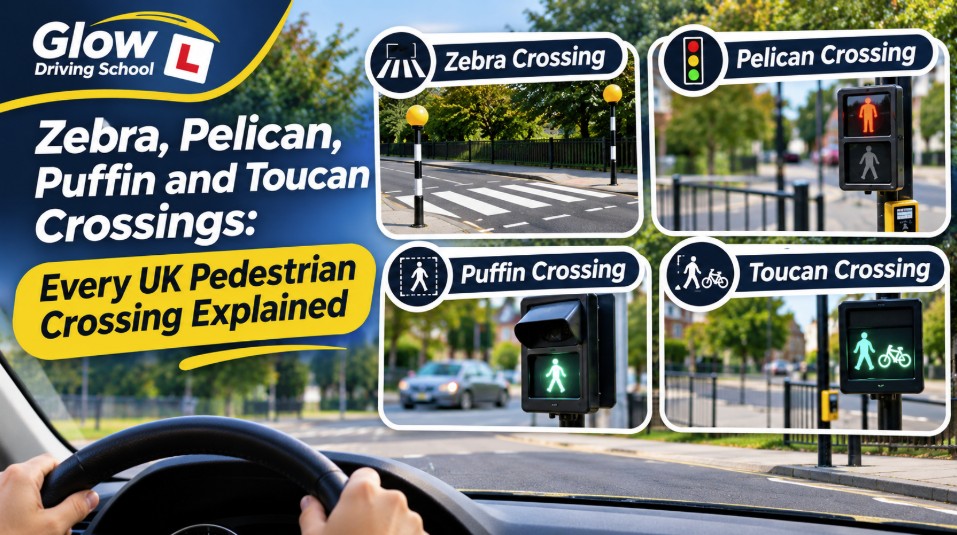
Britain names its pedestrian crossings after birds, which is charming until you are sitting at the wheel trying to remember whether this is the one with the flashing amber light. There are seven types in use, they behave differently, and the rules changed meaningfully in 2022 in a way that many drivers still have not caught up with.
This guide covers all of them properly: what each one looks like, what the law requires rather than merely suggests, where they catch learners out, and what it costs if you get it wrong.
First, a small myth: there is no such thing as a pecan crossing
It comes up often enough to be worth saying plainly. There is no pecan crossing. The word people are reaching for is puffin, and the confusion is understandable, because the names are not really bird names at all. They are acronyms that were bent into bird shapes afterwards:
- Pelican comes from PEdestrian LIght CONtrolled. It was originally spelled “pelicon”, which gives the game away.
- Puffin comes from Pedestrian User Friendly INtelligent.
- Toucan comes from “two can cross”, because pedestrians and cyclists use it together.
- Zebra is the only honest one. It is named after the stripes.
- Pegasus is named after the winged horse, because it is the crossing for horse riders.
Once you know that pelican means light-controlled and puffin means intelligent, the differences between them stop being arbitrary trivia and start making sense.
The mental model that makes all of this easier
Before the individual types, there is one distinction worth holding onto, because every other rule hangs off it.
Uncontrolled crossings have no traffic lights. Priority is decided by judgement, yours and the pedestrian’s. Zebra and parallel crossings are the two of these.
Light-controlled crossings have signals, and priority is decided by the lights. Pelican, puffin, toucan and equestrian crossings are these.
Learners find the uncontrolled ones harder, which surprises people who assume lights add complexity. In fact lights remove the decision. At a zebra you have to read a person’s intention from their body language on a wet pavement at thirty miles an hour, and that is a genuinely difficult skill.
Zebra crossings
The oldest and still the most common. Black and white stripes across the carriageway, flanked by Belisha beacons — the amber globes on black and white poles, named after Leslie Hore-Belisha, the Minister of Transport who introduced them in 1934. Zig-zag white lines run along the approach on both sides.
What the law requires
Under Rule 195 of the Highway Code, you must give way once a pedestrian has stepped onto the crossing. That is a legal requirement, not advice.
Here is the part that changed, and it matters. Since the 2022 Highway Code revision introduced the hierarchy of road users, Rule H2 also says drivers should give way to pedestrians waiting to cross a zebra crossing — not only those already on it. The wording is advisory rather than a legal must, but it reflects what examiners now expect and what the courts will weigh after a collision. In practice: if someone is standing at the kerb looking like they intend to cross, stop.
The things that catch people out
- A zebra with a central island counts as two separate crossings. Someone crossing the far half has no priority over your half, and vice versa. Rules 19 and 20 cover this from the pedestrian’s side.
- Do not wave people across. Rule 195 is explicit: no waving, no flashing your headlights, no sounding the horn to invite someone over. It feels polite and it is genuinely dangerous, because you cannot see what the driver in the next lane is doing and the pedestrian is trusting your judgement instead of their own.
- Equally, do not hurry anyone. No revving, no creeping forward, no horn.
- Watch the sides. Pedestrians approach from beside the crossing, not just from directly in front of it.
- Allow more room in the wet. Your stopping distance roughly doubles, and a pedestrian stepping out assumes you can stop.
Parallel crossings, also called tiger crossings
A zebra crossing with a cycle route running alongside it, so cyclists can ride across instead of dismounting. Belisha beacons, same stripes, plus a marked cycle lane beside them.
These were first introduced in the UK in 2015. You will hear them called tiger crossings, a nickname left over from early trials that used yellow stripes on black tarmac. The official term in law and in design guidance is parallel crossing, and the tiger name is formally discouraged because it has been used to mean several different things over the years. Both terms will get you understood.
The rules mirror a zebra, with cyclists included: under Rule 195 you must give way to cyclists already on the crossing, and should give way to those waiting. Rule H2 makes the same point.
Worth knowing for London driving: a cyclist approaches far faster than a pedestrian, so the gap between “nobody there” and “someone committed to crossing” is much shorter than your instincts expect.
Pelican crossings
Introduced in Britain in 1969, the pelican was the first light-controlled crossing in the UK that pedestrians operated themselves. You press a button, and in time the lights stop the traffic.
Two features identify a pelican:
- The pedestrian signals are on the far side of the road, facing you across the carriageway.
- It has a flashing amber phase. This is the only crossing type in the UK that does.
The flashing amber phase
This is the single most misunderstood signal on British roads, so it is worth being precise. Rules 196 and 197 set it out: you must stop at a red light, and when the amber light is flashing you must give way to any pedestrian still on the crossing. If the crossing is clear, you may proceed with caution.
So flashing amber does not mean go, and it does not mean wait. It means the crossing now belongs to anyone still on it, and to nobody else.
From the pedestrian’s side, Rule 22 pairs with this: press the button, never cross on red, and on a steady green check that traffic has actually stopped before stepping out. A flashing green figure means do not start crossing — finish if you are already out there.
One more quirk: a pelican that runs straight across the road is a single crossing even where there is a central island. That is the opposite of the zebra rule, and it means you must wait for people coming from the far side of the island.
Puffin crossings
A puffin looks like a pelican at a glance and behaves quite differently. It is the modern replacement, and most new signal-controlled crossings built today are puffins.
Two differences give it away:
- The pedestrian signals are on your side of the road, mounted at the near kerb and angled slightly towards the waiting pedestrian. This lets someone watch the signal and the traffic at the same time rather than staring across the road.
- There is no flashing amber phase. The sequence runs like ordinary traffic lights.
What makes it “intelligent”
Sensors above the signals do the thinking. A kerb detector notices whether someone is still waiting, and a crossing detector notices whether anyone is still on the road. The practical effects are neat: if a slower pedestrian needs longer, the red light holds for them. If someone presses the button and then crosses in a gap or walks off, the system cancels the request rather than stopping traffic for nobody.
That last behaviour is why puffins reduce the pointless red lights that make drivers impatient at pelicans, and it is a good thing to understand rather than resent.
Rule 199 covers puffins alongside toucan and equestrian crossings: no flashing amber, normal light sequence, proceed with extreme caution if the signals are not working, and never enter unless you can clear the crossing completely.
Toucan crossings
Two can cross. A light-controlled crossing shared by pedestrians and cyclists, who get the green signal at the same time, and cyclists may ride across rather than dismounting (Rule 25).
You will find them where a cycle path meets a road, which in South West London means plenty of them along the Wandle Trail and around the park edges. They are wider than a standard crossing, and the pedestrian signal carries a cycle symbol alongside the walking figure.
For drivers the rules are those of Rule 199: normal signal sequence, no flashing amber, and expect something to arrive across your path considerably faster than walking pace.
Equestrian crossings, also called pegasus crossings
Crossings for horse riders, found near stables, bridleways and commons. Rule 27 describes them: pavement barriers, a wider crossing space, and signals showing a horse and rider symbol. There is often a parallel crossing for pedestrians right beside one.
The giveaway feature is a second push button mounted high up, around two metres, so a rider can reach it without dismounting. A lower button serves anyone on foot.
Drivers follow Rule 199 again, with one addition worth taking seriously: give horses a very wide berth and keep the engine note down. A horse that spooks on a carriageway is a danger to the rider, to you and to everyone behind you. Patience costs you fifteen seconds.
School crossing patrols
Not a crossing type as such, but it belongs in any honest list because the legal duty is the strongest of the lot.
When a school crossing patrol shows the stop sign, you must stop. Rule 29 covers it from the pedestrian’s side: do not cross until the patrol, a police officer or a traffic warden signals you to, and always cross in front of them.
Failing to stop for a school crossing patrol carries far heavier consequences than most crossing offences — a fine of up to £1,000 and the possibility of disqualification. Treat the lollipop as an absolute.
Crossings at traffic lights and junctions
The green man built into an ordinary set of traffic lights is not one of the seven named types, but it is where most urban crossing happens, and the 2022 rules changed the picture here too.
Rule H2 says that at junctions you should give way to pedestrians crossing, or waiting to cross, the road you are turning into or out of. In plain terms: if you are turning left into a side road and someone is waiting to cross it, they go first. A great many drivers still do not do this, and it is one of the clearest behaviours separating a driver who has read the current Highway Code from one working off memory.
Rule 21 adds the pedestrian’s side: a pedestrian who has started crossing has priority even if a vehicle turns into the road.
All seven at a glance
| Type | Lights? | Flashing amber? | Signal position | Who it is for |
|---|---|---|---|---|
| Zebra | No | No | Belisha beacons | Pedestrians |
| Parallel (tiger) | No | No | Belisha beacons | Pedestrians and cyclists, separate lanes |
| Pelican | Yes | Yes | Far side of the road | Pedestrians |
| Puffin | Yes | No | Near side, with sensors | Pedestrians |
| Toucan | Yes | No | Near side | Pedestrians and cyclists, shared |
| Equestrian (pegasus) | Yes | No | Near side, high button | Horse riders |
| School patrol | No | No | Stop sign held by patrol | Children and the patrol |
The rules that apply at every crossing
Whichever type you are approaching, these hold. Note the difference between must and should: must is a legal requirement with a penalty attached, should is advisory but will still be held against you after a collision and marked against you on test.
- Rule 191. You must not park on a crossing or within the zig-zag lines. You must not overtake the moving vehicle nearest the crossing, nor the nearest vehicle that has stopped to let someone cross.
- Rule 192. In queuing traffic, keep the crossing clear. Never enter unless you can clear it completely.
- Rule 193. Take extra care where parked vehicles or a queue block your view of the crossing. People step out between stationary cars.
- Rule 194. Give pedestrians plenty of time, and do not harass them by revving or edging forward.
- Rule 198. When your signal turns green, give way to anyone still crossing.
Rule 191’s overtaking ban deserves emphasis, because it is where the serious collisions happen. A stopped vehicle at a crossing is a wall you cannot see past. The pedestrian walking out from behind it cannot see you either.
What it costs to get wrong
Crossing offences carry real consequences, and some are enforced by camera rather than by an officer.
- Failing to comply at a zebra crossing, including the zig-zag lines: a £100 fine and three penalty points, under section 36(1) of the Road Traffic Act 1988.
- Parking or stopping on a crossing or its zig-zags: a penalty charge notice from the council. In Merton, where many of our pupils learn, stopping on school zig-zags attracts a £130 charge, reduced to £65 if paid within 21 days, and the council enforces it with mobile CCTV vans. Blue badge holders get no exemption.
- Failing to stop for a school crossing patrol: up to £1,000 and possible disqualification.
If you have passed within the last two years, three points is also a third of the way to losing your licence, since six points in that period means revocation and sitting both tests again.
What examiners actually watch for
Crossings appear on virtually every test route in South West London, and the faults cluster predictably.
- Late observation. Examiners want to see you scanning the pavement on both sides well before you arrive, not reacting at the zig-zags.
- Stopping for nobody. Braking at an empty zebra is a fault for undue hesitation and poor progress. The crossing is not an instruction to stop.
- Not stopping for somebody waiting. The flip side, and since 2022 the clearer fault of the two.
- Treating flashing amber as a red light. Sitting at a clear crossing through the whole amber phase holds up traffic unnecessarily.
- Treating flashing amber as a green light. Far more serious, and potentially a dangerous fault.
- Stopping on the crossing itself in queuing traffic.
- Overtaking a vehicle that has stopped at a crossing. This is usually marked dangerous, and rightly.
For more on where faults cluster locally, see our guide to why learners fail the driving test.
Where you will meet these on local test routes
Crossings are not evenly distributed, and knowing what your route holds is worth more than general theory.
- Morden and Mitcham routes run through dense residential grids with a high concentration of zebra crossings, many of them near schools with zig-zags that are actively enforced.
- Tolworth routes take in the Kingston Road 20mph stretch, where signalled crossings sit close together and the temptation is to roll towards a red.
- Isleworth routes include crossings on the approaches to the A4, where the speed differential between the dual carriageway and the side roads makes late observation genuinely risky.
- Croydon routes combine crossings with tram crossings, which is a layered observation task that few other London centres demand.
Our test centre guides break down the routes at each one, including Morden, Mitcham and Tolworth.
Crossings on the theory test
Crossings are a reliable source of theory test questions, and the ones that trip candidates up are almost always about the flashing amber phase and about which crossing has its signals where. The two facts to lock in:
- The pelican is the only crossing with a flashing amber phase, and during it you give way to anyone on the crossing.
- Pelican signals are across the road; puffin signals are on your side.
For the wider road-sign side of the theory test, see our guide to UK traffic signs, and for the booking process, how to book your theory test.
Frequently asked questions
What is a pecan crossing?
It does not exist. The crossing people mean is a puffin, from Pedestrian User Friendly INtelligent. The seven real types are zebra, parallel, pelican, puffin, toucan, equestrian and school crossing patrols.
What is the difference between a pelican and a puffin crossing?
Two things. A pelican has a flashing amber phase and its pedestrian signals sit on the far side of the road. A puffin has no flashing amber, its signals are on your side of the road, and sensors adjust the timing to the people actually crossing.
Do I have to stop for someone waiting at a zebra crossing?
You must stop once they have stepped onto the crossing. Since 2022, Rule H2 also says you should give way to someone waiting to cross. The first is a legal requirement; the second is advisory but is what examiners expect and what would count against you after a collision.
What does a flashing amber light at a crossing mean?
Give way to anyone still on the crossing. If it is clear, you may go on with caution. It appears only at pelican crossings.
Can cyclists ride across a zebra crossing?
A zebra is for pedestrians, so a cyclist should dismount and push. On a parallel crossing or a toucan crossing, cyclists may ride across, and drivers must give way to them in the same way as to pedestrians.
Is a zebra crossing with an island one crossing or two?
Two separate crossings. A pelican running straight across is the opposite: one crossing, even with an island. Staggered crossings, where the two halves are not in line, count as two.
Can I be fined for stopping on the zig-zag lines?
Yes. It is a £100 fine and three penalty points as a police matter, and councils also issue penalty charge notices through civil enforcement, often using CCTV near schools. Merton charges £130, halved to £65 if you pay within 21 days.
Why should I not wave a pedestrian across?
Because you cannot see what other drivers are doing, and you are asking someone to replace their own judgement with yours. Rule 195 specifically tells drivers not to wave, flash their lights or sound the horn to invite a pedestrian across.
What happens if the lights at a crossing are not working?
Treat it with extreme caution and give way as though it were an uncontrolled crossing. Rule 199 says exactly this for puffin, toucan and equestrian crossings.
Which crossing is best for a nervous learner to practise first?
Light-controlled ones, because the signal makes the decision for you. Zebra crossings need judgement about a stranger’s intentions, which is a harder skill and worth building up to deliberately.
Want to practise these on real roads? We teach manual and automatic lessons across Wimbledon, Morden, Mitcham, Tooting, Balham, Putney, Kingston and Battersea, and we work crossings into lessons on the roads where your test will actually take you. See our lesson prices, read about manual driving lessons, or book your first lesson.
Rules and rule numbers in this article are from the current edition of the Highway Code on GOV.UK, correct as at November 2026. Penalty figures are from the Road Traffic Act 1988 and Merton Council’s published charges. The Highway Code is updated periodically, so check GOV.UK for the current wording.