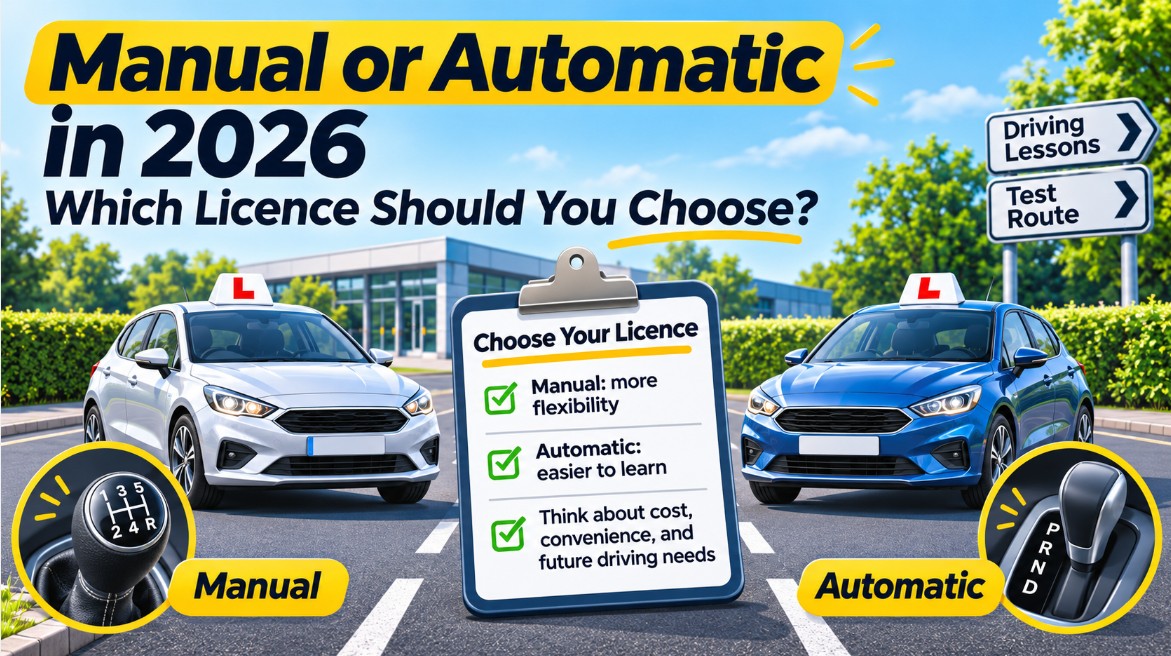
Learn manual unless you have a specific reason not to. The reason is not that manual is better driving, it is that a manual pass gives you a licence covering both transmissions, and an automatic pass does not. That restriction follows you for the rest of your driving life unless you sit a second practical test.
That said, “learn manual” is the right default, not the right answer for everyone. Here is how to decide.
The one difference that matters
Pass in a manual and you hold a full category B licence. You can drive manual and automatic cars, hire cars anywhere, work vehicles and vans within the weight limits.
Pass in an automatic and your licence carries a restriction code limiting you to automatic vehicles. Driving a manual car on that licence means driving otherwise than in accordance with your licence, which typically invalidates your insurance as well. We cover the licence mechanics in detail in what type of licence you get from automatic lessons.
Everything else about this decision is a trade-off. This part is binary.
What has genuinely changed
The automatic case is much stronger than it was five years ago, and it is worth being honest about that.
Industry figures suggest around 92% of new cars ordered in the UK in the first half of 2026 were automatic, driven by electric and hybrid vehicles. Every fully electric car is effectively an automatic. If you expect to be driving a car bought new in the 2030s, the odds that it has a clutch are small.
What has not changed is the second-hand market, the hire market and the work vehicle market, which is where most people under 25 actually drive. That is the gap the restriction sits in.
Choose manual if
- You want the widest set of options and have no pressing deadline
- You might drive a work vehicle or van, or any job might ask you to
- You will hire cars, especially abroad, where manual is still the default and automatics cost more
- You will borrow family or friends’ cars, which are more likely to be older and manual
- You are 17 and have no idea what you will be driving in ten years, which is most 17-year-olds
Choose automatic if
- You need a licence by a specific date for a job or a move, and speed matters more than breadth
- You already drive an automatic or will be buying an EV
- Clutch control is genuinely blocking your progress, and you have given it a fair run
- You have a medical condition, disability or anxiety that makes managing a clutch and gears alongside observation unmanageable
- You are an older learner returning after a long gap and want to reduce the number of things to think about at once
That fourth and fifth point are the reasons we most often recommend automatic, and we recommend it without hesitation when they apply. Spending twenty hours fighting a clutch is not a character-building exercise, it is wasted money.
Cost and pass rates compared
| Manual | Automatic | |
|---|---|---|
| Licence covers | Manual and automatic | Automatic only |
| Typical hours to test standard | Around 40 to 45 | Around 30 to 35 |
| Hourly rate | Lower | Usually slightly higher |
| Typical total cost | Broadly similar | Broadly similar |
| Practical test fee | £62 weekday | £62 weekday |
| Pass rate | Around 47 to 48% | Around 42 to 43% |
The pass rate difference surprises people, since automatic driving is simpler. One significant reason is who sits each test: the automatic cohort includes a large number of learners who switched across after struggling in a manual, which pulls the average down. It is not evidence that automatic tests are harder.
Totals land closer together than the hourly rates suggest, because fewer hours at a higher rate roughly cancels out. For the full picture see what it really costs to learn to drive.
Upgrading later: what it actually costs
You can convert an automatic licence to a full manual one at any time, and you do not have to retake the theory test. You keep your automatic entitlement throughout, and you sit a full manual practical test.
In practice that means the £62 test fee, access to a manual instructor car, and usually 10 to 20 hours of conversion lessons. Expect roughly £500 to £1,000 all in, plus another spell on a waiting list that in London currently runs months rather than weeks.
So the honest framing is this: choosing automatic is not choosing a cheaper route, it is choosing to pay less now and possibly more later. If you are confident you will never need a manual, that is a perfectly rational trade. If you are guessing, manual is the cheaper guess.
Does automatic make sense in London specifically?
There is a real argument for it. Stop-start traffic on the A23, A24 and A3 means constant clutch work, and congestion is where automatics are genuinely more pleasant. Several of our pupils who switched did so after a few lessons in Tooting or Balham traffic.
The counter-argument is also local: London learners are among the most likely to hire cars for trips out of the city and to drive work vehicles, both of which lean manual. Choose on what you will drive, not on what your lessons feel like.
Can you switch part-way through?
Yes, in either direction, and plenty of people do. Switching from manual to automatic after fifteen or twenty hours is common and the hours are not wasted, because observation, positioning, junctions and roundabouts all transfer. Only the clutch and gear work does not.
Switching the other way is harder, because you are adding a skill rather than removing one. If you think there is any real chance you will want a manual licence, start manual.
Frequently asked questions
Can I drive a manual car if I passed in an automatic?
No. Your licence is restricted to automatic vehicles, and driving a manual on it breaches your licence and generally invalidates your insurance. You would need to pass a manual practical test first.
Do I have to retake the theory test to upgrade to manual?
No. Your theory pass carries over. You only need to pass a full manual practical test, and you keep your automatic entitlement while you do it.
Is the automatic driving test easier?
The test is identical apart from the absence of gear changes, and the pass rate for automatic tests is actually slightly lower, at roughly 42 to 43% against 47 to 48% for manual. That largely reflects who takes it rather than its difficulty.
Are automatic driving lessons more expensive?
Usually slightly more per hour, but learners often need fewer hours, so total costs tend to be similar. See our pricing page for our current rates.
Will manual cars disappear?
New ones largely have: industry figures put automatic at around 92% of new UK car orders in early 2026. The existing second-hand fleet, hire cars and work vehicles will include manuals for many years, which is why the restriction still matters.
Is an automatic licence a problem for jobs?
It can be. Any role involving a van, a pool car or a work vehicle may specify a full manual licence. If your career might involve driving at all, manual keeps the door open.
I keep stalling. Should I switch to automatic?
Give it a fair run first, because clutch control almost always clicks, usually somewhere between hours six and twelve. If it genuinely is not improving after that and it is damaging your confidence elsewhere in your driving, switching is a sensible decision rather than a defeat.
Which should a nervous learner choose?
Automatic removes two things to think about and lets you put that attention on observation and road position, which is what the test is actually about. For an anxious learner that is often the difference between progress and stalling out.
Not sure which to choose? We teach both across Wimbledon, Morden, Mitcham, Tooting, Putney and Kingston, and we will tell you honestly which suits you after a first lesson. See manual lessons, automatic lessons, or book a lesson.
Test fees are DVSA published rates. Pass rate and new car transmission figures are industry and DVSA-derived data current to 2026 and will move over time.