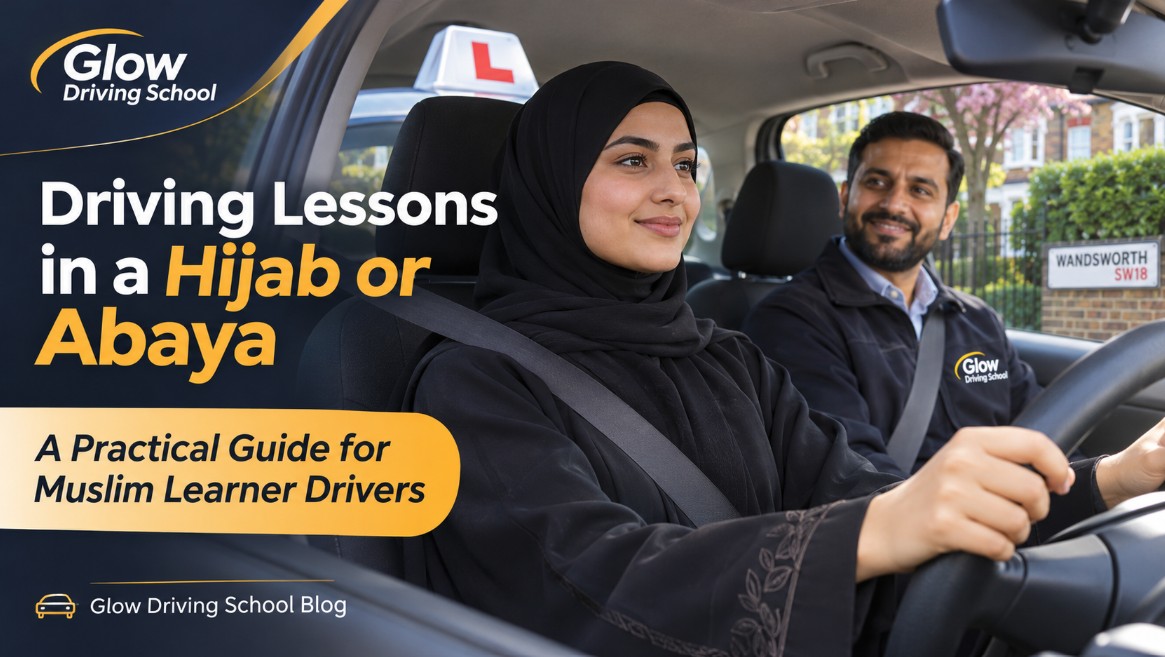
Learning to drive while wearing a hijab or an abaya raises a handful of practical questions that general driving guides never answer. Can you keep your head covering on for the licence photo? What happens at the identity check before your test? Will anyone ask you to remove anything? Can you request a female instructor?
The short version is reassuring: the rules accommodate religious dress, they are written down, and examiners follow a set procedure rather than making it up on the day. This guide sets out exactly what to expect, plus the practical clothing and safety points that matter once you are actually behind the wheel.
Your provisional licence photo
You can wear your hijab in your driving licence photo. The DVLA applies the same photo standard as the passport office, and the rule is that your photo must not include a head covering unless it is worn for religious or medical reasons. A hijab, headscarf, turban or kippah is therefore fine.
What the rule does require is that nothing covers your face. The photo standard says your face must not be covered, your eyes must be open and clearly visible, and your hair must not fall across them. So a hijab is accepted; a niqab or face veil is not, because the face has to be visible for identity verification.
Two small practical points that save a rejected application:
- Pin the fabric back slightly from your cheeks so the full width of your face is in frame, from hairline to chin.
- Check for shadows. The standard prohibits shadows on the face, and a scarf worn close to the head can throw one across one side. Even, front-on lighting solves it.
If you already hold a UK passport, the DVLA can reuse that photo when you apply online, which sidesteps the problem entirely.
The identity check before your driving test
This is the part most learners worry about, and it is worth knowing that the DVSA has a written procedure for it. It sits at section 6.15 of the official examiner guidance, and it distinguishes clearly between the two garments: a hijab covers the head, while a head covering worn together with a veil is a niqab.
If you wear a hijab
Nothing happens. Your face is visible, so the examiner checks your provisional licence against your face as they would for any candidate. There is no request to remove anything and no special procedure.
If you wear a niqab
The examiner does need to see your face once, to confirm you are the person named on the licence. The guidance sets out how that is handled:
- A female examiner makes the request wherever possible, courteously and with an explanation of why it is being asked.
- If no female examiner is available, you will be asked whether you would prefer a female approved driving instructor, or a friend or relative, to be present while your identity is confirmed.
- The check should take place in a private area where one is available, rather than in the open test centre.
Being clear about the one hard limit: if a candidate wearing a niqab declines under any circumstances to reveal their face, the examiner will explain that the test cannot go ahead and that the fee is lost. The identity check is not optional, because the licence is issued to a named person. Knowing that in advance is better than discovering it at the test centre.
It is worth saying that this is not a rule aimed at Muslim candidates. The same guidance tells examiners that a Sikh candidate keeps their kirpan rather than being asked to remove it. The DVSA’s general position is to accommodate religious observance and to insist only on what identity verification genuinely requires.
Asking for a female instructor
You are entitled to ask, and it is a common request rather than an awkward one. Many learners prefer a female instructor for reasons of comfort, family preference or faith, and a good school will simply tell you honestly whether they have one available and what the waiting time is.
Worth asking at the same time:
- Whether the instructor can collect you from home, which some learners prefer to meeting at a public pick-up point
- Whether a relative can sit in on early lessons, if that would help you feel settled
- Whether lesson times can work around school runs or prayer times
Any school worth learning with will treat these as ordinary scheduling questions.
What to wear for lessons and for the test
There is no dress code for a driving test. What there is instead is Rule 97 of the Highway Code, which requires that your clothing and footwear do not prevent you from using the controls properly. That single sentence is the whole of the law, and it applies the same way to a long abaya as to a winter coat or a pair of heels.
In practice, a few adjustments make driving in modest dress considerably more comfortable, and they are worth getting right early rather than fighting them for forty hours of lessons.
Sleeves
Wide or heavily draped sleeves are the most common nuisance. They catch on the gear lever, the indicator stalk and the steering wheel during turns. A narrower cuff, or a sleeve you can push back, makes a noticeable difference to how smoothly your hands move around the wheel. This is one of the few genuine practical arguments for having a specific abaya you drive in.
Hem length
A long hem is fine. A hem that bunches around the pedals is not. Check that the fabric sits clear of your feet when you are in the driving position with the seat set correctly, and that it cannot slide forward under the pedals when you brake firmly. Lighter, less voluminous fabrics behave better here than heavy ones.
If you are buying with driving in mind, lighter-weight fabrics and a slimmer cut are the things to look for. Retailers specialising in modest fashion, such as Ayesha’s Collection, carry a range of fabric weights and cuts, and the lighter jersey and crepe styles tend to be the easiest to drive in.
Your hijab and your blind spots
This is the most important practical point in this article, and it is the one nobody mentions.
The driving test marks observation more heavily than anything else, and the single most common reason learners fail is ineffective observation at junctions. Effective observation means turning your head properly — over your shoulder for blind spots, fully both ways at junctions, and genuinely checking before every move-off and lane change.
A hijab styled tightly under the chin, or pinned in a way that anchors the fabric to your shoulder, can quietly restrict how far you turn your head. Many learners compensate by moving their eyes instead, which examiners spot immediately and mark as a fault, because the head movement is what tells them you actually looked.
The fix is simple: before a lesson or test, sit in the driving position and check that you can turn your head fully over each shoulder without the fabric pulling. If it pulls, a looser style around the neck, or a scarf secured at the back rather than the side, usually solves it. Worth testing in a mirror at home rather than discovering it at a junction.
Your seatbelt
The seatbelt must sit correctly on your body to work, which means the diagonal strap across your collarbone and chest, not slipping towards your neck or off your shoulder, and the lap strap low across your hips.
Bulky layers can hold the belt away from your body, which introduces slack. Loose fabric can also make the belt ride up towards the neck. Settle your layers first, then fasten the belt, then check the diagonal sits flat against you. If the car has an adjustable upper belt anchor, use it.
The belt will crease an abaya. That is unavoidable and not a reason to loosen it.
Footwear
No shoe is illegal to drive in, and that includes driving barefoot. But the body that regulates the driving test is clear that suitable shoes matter behind the wheel, and specifically advises against driving barefoot because you cannot apply the same braking force with a bare foot as with a shoe.
Thin-soled, secure footwear is what you want: trainers, plimsolls or flat shoes. What to avoid is backless sandals and flip-flops, which can slip off or wedge under a pedal, thick-soled boots, which destroy your feel for the pedals, and heels, which change the angle of your ankle.
Plenty of learners keep a pair of driving shoes in the car and change into them. There is nothing odd about it and examiners see it constantly.
Lessons during Ramadan
Worth planning for rather than pushing through. Fasting affects concentration, reaction time and patience, and all three are things you are actively trying to build during lessons. A lesson at four in the afternoon on a long fasting day is not good value.
Most learners who fast find that:
- Morning lessons work better than late afternoon ones, before fatigue and dehydration build
- Shorter sessions are more productive than two-hour blocks
- Test dates are worth avoiding in the last week or so, when tiredness is usually at its worst
Tell your instructor you are fasting. A good one will adjust the lesson plan, pick quieter routes for the harder days, and avoid introducing demanding new skills when you are running low. Given that practical test waiting times in London currently run to several months, it is worth thinking about where your test date is likely to land when you book it.
Learning in South West London
Glow teaches across Wimbledon, Morden, Mitcham, Tooting, Balham, Putney, Kingston and Battersea, and a good proportion of our pupils are Muslim learners from Mitcham, Tooting and Colliers Wood. The practical upshot is that none of the above is unfamiliar territory for us, and you will not have to explain it.
Our pupils test mainly at Morden, Mitcham and Tolworth. Our test centre guides cover the routes at each, including Morden, Mitcham and Tolworth.
Frequently asked questions
Can I wear a hijab in my driving licence photo?
Yes. The photo standard allows a head covering worn for religious or medical reasons. Your face must remain fully visible, with your eyes clearly in view and no shadows across your face.
Can I wear a niqab in my driving licence photo?
No. Nothing may cover the face in the photo, because the image is used for identity verification. A hijab is fine; a face veil is not.
Will the examiner ask me to remove my hijab?
No. A hijab leaves your face visible, so the normal identity check applies and nothing is removed.
What happens at the identity check if I wear a niqab?
You will be asked to reveal your face once so the examiner can confirm your identity. Wherever possible a female examiner makes that request, and if none is available you can ask for a female instructor or a friend or relative to be present. The check should happen in a private area where one exists.
What if I decline to remove my niqab?
The test cannot go ahead and the fee is lost. The identity check is a requirement, not a formality, because the licence is issued to a named individual.
Can I request a female driving instructor?
Yes, and it is a routine request. Availability varies by school and area, so ask early, as female instructors are often booked further ahead.
Can I drive in an abaya?
Yes. There is no dress code for driving or for the test. Rule 97 of the Highway Code simply requires that your clothing does not stop you operating the controls, so keep the hem clear of the pedals and the sleeves clear of the gear lever and indicators.
Can I drive in loose or flowing sleeves?
You can, but narrower cuffs make steering and gear changes considerably easier. Wide sleeves catch on the indicator stalk and the gear lever more than people expect.
Does wearing a hijab affect my blind spot checks?
It can, if the style restricts how far you can turn your head. Examiners look for visible head movement as evidence that you checked, so test your range of movement in the driving position beforehand and loosen the style around the neck if it pulls.
Should I book lessons during Ramadan?
You can, but earlier in the day and in shorter sessions. Fasting affects concentration and reaction time, which is exactly what lessons are training, so tell your instructor and let them adjust the plan.
Thinking about learning to drive? We teach manual and automatic lessons across South West London, and we are used to working around prayer times, school runs, fasting and requests for a female instructor. See our lesson prices, read about manual driving lessons, or book your first lesson.
Licence photo rules are the published GOV.UK photo standard. The identity check procedure is from section 6.15 of the DVSA’s guidance for driving examiners carrying out driving tests. Footwear and clothing guidance reflects Rule 97 of the Highway Code. Correct as at November 2026.