
What That Black-and-White Sign Actually Means — and Why It Confuses So Many Drivers
You are driving along a road and you pass a white circular sign with a single black diagonal stripe running from bottom left to top right. No number on it. No explanation. Just the stripe.
If you are not sure what speed you should be doing, you are not alone. The national speed limit sign is one of the most commonly misunderstood road signs in the UK, and it trips up learner drivers on theory tests and experienced drivers on real roads every day. The confusion exists because the sign does not tell you a specific speed. Instead, it tells you that the national speed limit applies, and that limit changes depending on the type of road you are on, the type of vehicle you are driving, and which country within the UK you are in.
This guide explains everything you need to know: what the national speed limit is, how it varies, what the sign looks like, how it applies differently in Wales, what happens when you break it, and why the speed limit is always a maximum, never a target.
What Is the National Speed Limit?
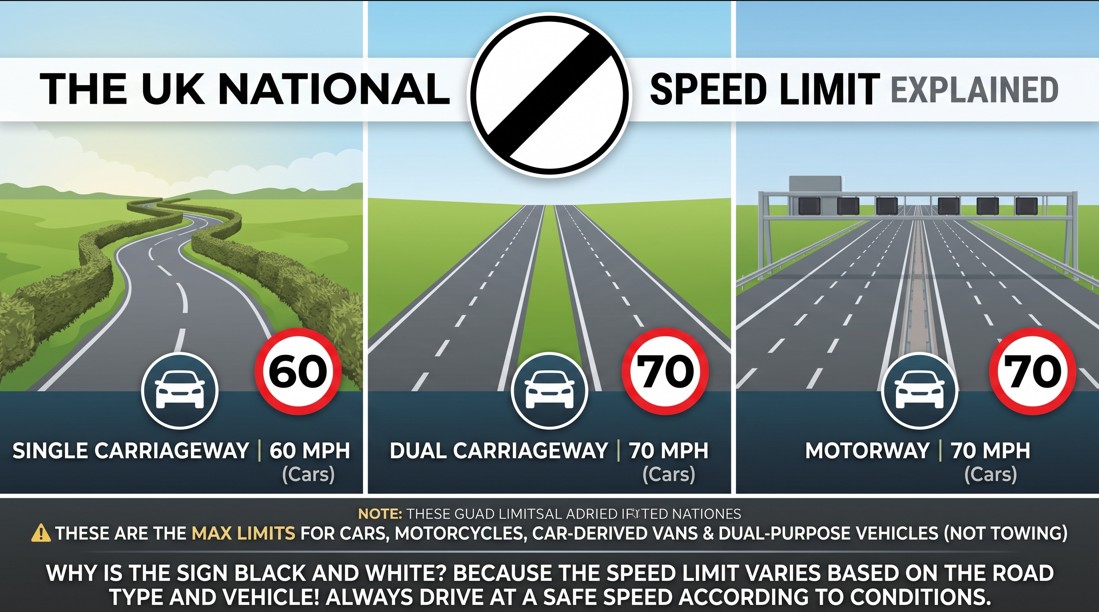
The national speed limit is the default maximum speed that applies on any road where no other specific speed limit is posted. If you do not see a sign showing a number (such as 30, 40 or 50 inside a red circle), the national speed limit is what governs how fast you can legally drive.
For cars and motorcycles in England, Scotland and Northern Ireland, the national speed limits are:
| Road Type | National Speed Limit |
|---|---|
| Single carriageway | 60 mph |
| Dual carriageway | 70 mph |
| Motorway | 70 mph |
| Built-up area (with street lighting) | 30 mph |
These are the limits that apply to cars, motorcycles, car-derived vans and dual-purpose vehicles that are not towing anything. If you are driving a larger vehicle, towing a trailer or driving in Wales, different limits apply, those are covered in detail further down this page.
What Does the National Speed Limit Sign Look Like?
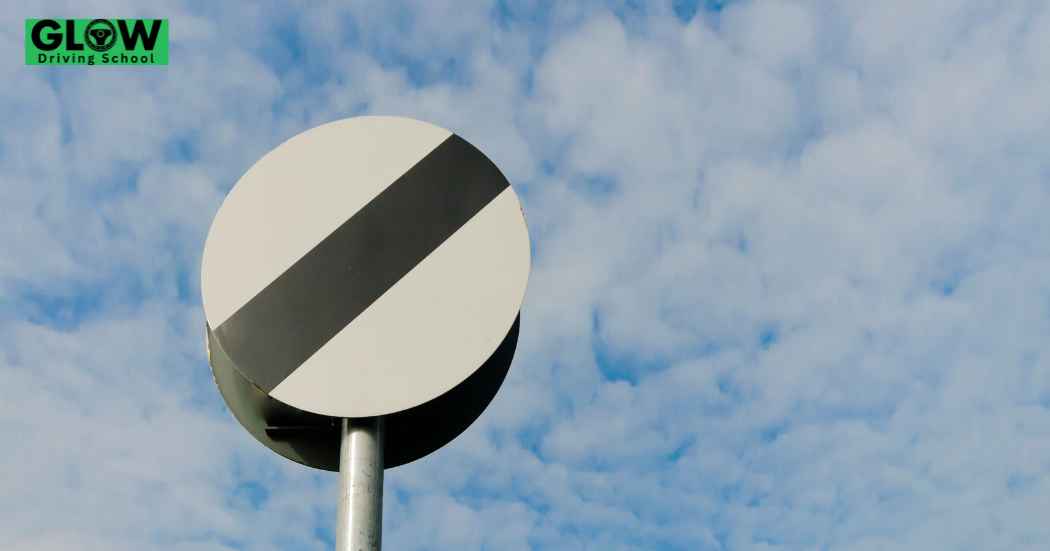
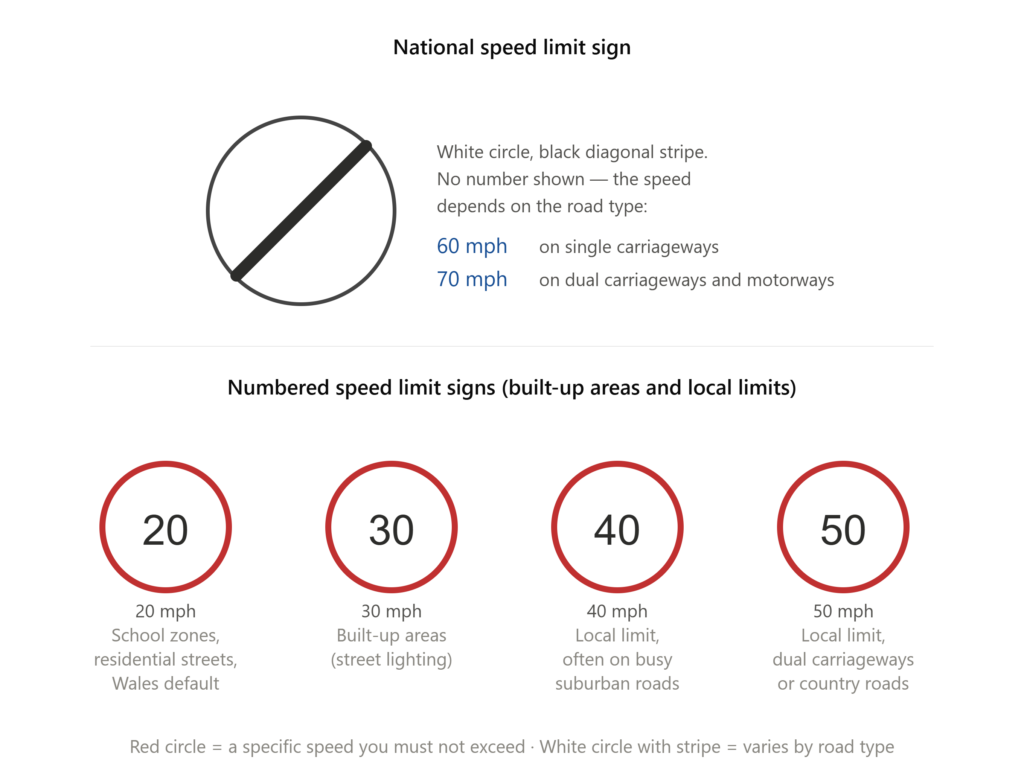
The national speed limit sign is a white circle with a single black diagonal stripe running from the bottom left to the top right. Unlike other UK speed limit signs, it does not show a number, because the speed it represents changes depending on the road.
You will see this sign at points where the national speed limit begins or resumes. For example, when you leave a town or village and enter an unrestricted single carriageway, you will typically see this sign. It means the default limit of 60 mph now applies (for cars), replacing whatever lower limit was in force inside the built-up area.
If you are revising for your theory test, learn to recognise this sign instantly. It appears in multiple-choice questions and hazard perception scenarios, and getting it wrong is one of the more common theory test mistakes.
Built-Up Areas — The 30 mph Default (and Why It Exists)
In England, Scotland and Northern Ireland, the default speed limit in a built-up area is 30 mph. You will usually see a 30 mph sign when you enter a town, village or city. But if there is no speed limit sign at all and the road has street lighting, you should assume that 30 mph applies.
The rule of thumb: if you can see three or more street lights in a row, spaced no further than 183 metres apart, the road is treated as a built-up area and the 30 mph limit applies, unless signs say otherwise.
The 30 mph limit exists because built-up areas carry a much higher risk of pedestrians stepping into the road, cyclists sharing the carriageway, parked cars obscuring your view and junctions appearing in quick succession. At 30 mph, the total stopping distance (thinking distance plus braking distance) is approximately 23 metres, about six car lengths. At 40 mph, that distance jumps to approximately 36 metres. That difference is the margin between stopping in time and a serious collision.
Many built-up areas in England now also have locally set 20 mph zones, particularly near schools, in residential streets and in town centres. These are indicated by round signs showing “20” in a red circle. London, in particular, has adopted 20 mph limits across large parts of the city. If you are learning to drive in South West London, you will encounter 20 mph zones regularly, they are now the norm rather than the exception in areas like Wimbledon, Tooting, Mitcham and Balham.
Wales — The 20 mph Default
Since September 2023, Wales has had a different default speed limit from the rest of the UK. On restricted roads, roads with street lighting that would default to 30 mph in England, the limit in Wales is now 20 mph.
This makes Wales the first country in the UK to lower the default built-up area speed limit from 30 to 20 mph. The change applies automatically to most residential streets and town centres across Wales. Some busier roads have been formally retained at 30 mph by local authorities, and these are signposted accordingly.
If you are driving in Wales and you see street lights but no speed limit sign, the default is now 20 mph, not 30 mph. Repeater signs (the smaller signs on lamp posts) are no longer used for the 20 mph default in Wales — you simply need to know the rule.
Early DVSA data shows that the change has been effective: vehicle speeds on 20 mph roads in Wales fell by an average of 3.8 mph in the first year, and casualties on affected roads decreased by 26.2%.
If you are a learner in England preparing for your theory test, you should still know about the Wales rule, it is part of the UK driving law landscape and may appear in theory test questions, particularly in the context of different speed limits applying in different parts of the UK.
Single Carriageways — 60 mph
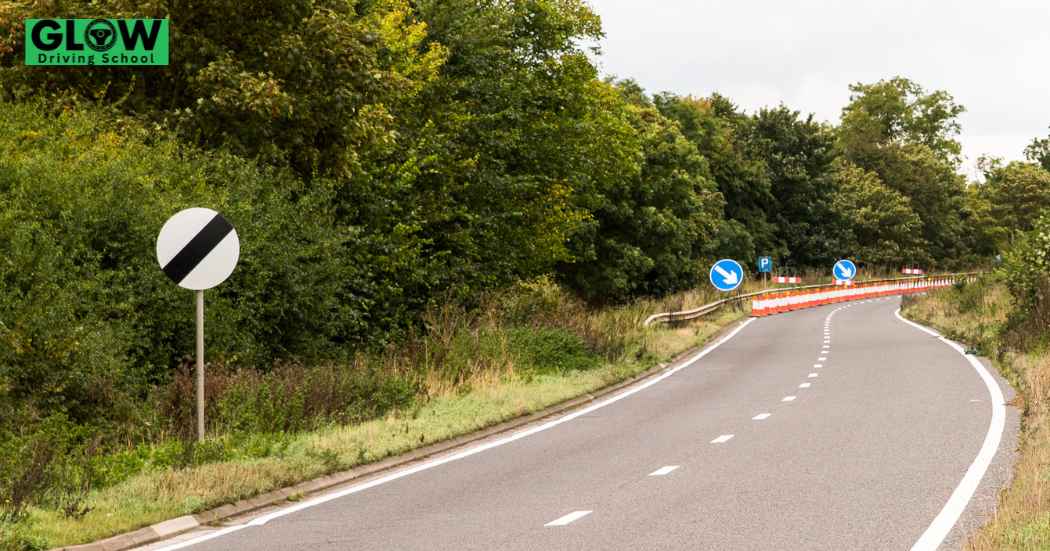
The national speed limit on single carriageways, roads where traffic in opposite directions is not separated by a central reservation, is 60 mph for cars.
This is the limit that catches most learners off guard. A narrow, winding country lane with hedgerows on both sides, no pavement and barely enough room for two cars to pass is, technically, subject to the same 60 mph national speed limit as a wide, straight A-road with clear sightlines.
That does not mean you should drive at 60 mph on a narrow lane. 60 mph is the absolute maximum, not a target. You must always drive at a speed that allows you to stop safely within the distance you can see to be clear. On a blind bend with no verge and a hidden dip ahead, 30 mph might be too fast, let alone 60.
The key factors to consider on single carriageways:
Visibility. If you cannot see around the next bend, slow down. You do not know what is waiting on the other side, a tractor, a horse, a broken-down vehicle, a pedestrian walking in the road (there are no pavements on many rural roads).
Road width. On roads where two vehicles can barely pass, reduce your speed and be ready to stop or give way. Pulling in tight to a hedge at 50 mph is not safe driving.
Surface condition. Wet roads, loose gravel, mud from farm vehicles, fallen leaves in autumn, all of these reduce your grip and increase your stopping distance.
Other road users. Cyclists, horse riders and walkers are all common on single carriageways, particularly rural ones. Give them space and time.
Dual Carriageways — 70 mph
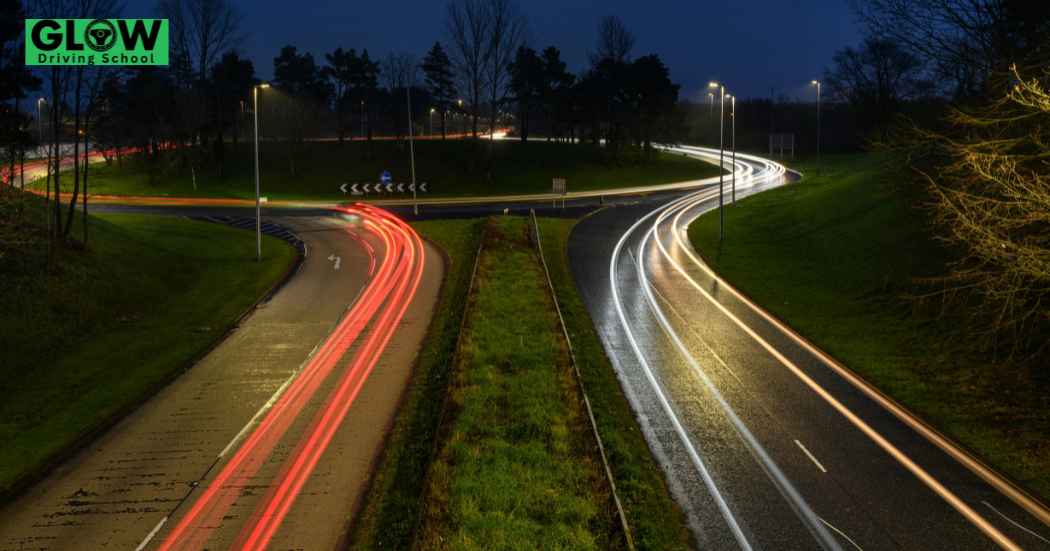
The national speed limit on dual carriageways is 70 mph for cars. A dual carriageway is any road where traffic travelling in opposite directions is separated by a central reservation, a physical barrier such as a grass verge, metal barrier or concrete divider.
Not all dual carriageways have two or more lanes in each direction. A road can be a dual carriageway with just one lane in each direction, as long as there is a central reservation dividing them. What matters is the physical separation, not the number of lanes.
Many learners confuse dual carriageways with motorways. The speed limit is the same (70 mph for cars on both), but dual carriageways are not motorways, they can have roundabouts, traffic lights, pedestrian crossings and direct access from side roads, none of which you will find on a motorway. This means you need to be ready for a wider range of hazards on a dual carriageway, even at the same speed limit.
If you are taking your test at Tolworth, your examiner may take you onto the A3 dual carriageway, where you will need to merge at speed, maintain lane discipline and read overhead signs. At Mitcham (currently testing from the Hilton Hotel on Purley Way), the A23 dual carriageway features on most routes. These are real dual carriageway experiences that test your ability to handle 40–60 mph traffic, though the speed limits on those sections may be lower than the 70 mph national limit due to local restrictions.
Motorways — 70 mph
The national speed limit on motorways is 70 mph for cars. Motorways are the fastest roads in the UK and are designed for high-speed, long-distance travel with no junctions, roundabouts or traffic lights.
However, the 70 mph limit is increasingly overridden by variable speed limits on smart motorways, where electronic overhead signs can reduce the limit to 60, 50, 40 or even 20 mph in response to traffic conditions, incidents or roadworks. When a speed limit is displayed inside a red circle on an overhead gantry, it is mandatory and enforced by cameras, it is not advisory.
Learner drivers have been allowed to take lessons on motorways since 2018, but only with a DVSA-approved instructor in a dual-control car. The motorway does not feature on the standard practical driving test, but it is covered in the Pass Plus course. If you pass your test and want to build motorway confidence, Glow Driving School offers motorway lessons and Pass Plus courses.
Speed Limits by Vehicle Type — The Full Table
The national speed limit is not the same for all vehicles. Cars and motorcycles follow one set of limits, but vans, lorries, buses and vehicles towing trailers have lower limits on certain roads. Here is the complete table, drawn from GOV.UK data (current as of 2026):
| Vehicle | Built-up area | Single carriageway | Dual carriageway | Motorway |
|---|---|---|---|---|
| Cars, motorcycles, car-derived vans, dual-purpose vehicles | 30 mph | 60 mph | 70 mph | 70 mph |
| Cars/motorcycles towing a caravan or trailer | 30 mph | 50 mph | 60 mph | 60 mph |
| Motorhomes up to 3.05 tonnes unladen | 30 mph | 60 mph | 70 mph | 70 mph |
| Motorhomes over 3.05 tonnes unladen | 30 mph | 50 mph | 60 mph | 70 mph |
| Goods vehicles up to 7.5 tonnes | 30 mph | 50 mph | 60 mph | 70 mph* |
| Goods vehicles over 7.5 tonnes (England & Wales) | 30 mph | 50 mph | 60 mph | 60 mph |
| Goods vehicles over 7.5 tonnes (Scotland) | 30 mph | 40 mph | 50 mph | 60 mph |
| Buses/coaches up to 12m | 30 mph | 50 mph | 60 mph | 70 mph |
| Buses/coaches over 12m | 30 mph | 50 mph | 60 mph | 60 mph |
*Reduced to 60 mph if articulated or towing a trailer.
Note: In Wales, the built-up area column is 20 mph for all vehicle types listed above.
Why this matters for learner drivers: You are most likely driving a car, so the top row is what applies to you. But the theory test expects you to know that other vehicles have different limits, particularly goods vehicles, which are 10 mph slower than cars on single carriageways and dual carriageways. If you see a lorry sitting at 50 mph on a 60 mph single carriageway, it is not driving slowly, it is driving at its legal maximum.
How Speed Limits Are Enforced
Speed limits are enforced through a combination of fixed cameras (the yellow Gatso and SPECS average-speed cameras), mobile camera units operated by police or safety camera partnerships, and police officers in patrol cars or on motorcycles.
The informal threshold: There is a widely known guideline that police forces typically do not prosecute until a driver exceeds the speed limit plus 10% plus 2 mph. Under this guideline, in a 30 mph zone, enforcement would begin at 35 mph. In a 70 mph zone, it would begin at 79 mph. However, this is not a legal buffer, it is an operational guideline, and police officers have full discretion to enforce the exact posted limit. Driving at 31 mph in a 30 zone is breaking the law, regardless of whether you are likely to be prosecuted.
Penalties for speeding in the UK:
| Offence level | Fine | Points |
|---|---|---|
| Minimum penalty | £100 fixed penalty | 3 points |
| Speed awareness course (if offered) | ~£100 course fee | No points |
| Court summons (serious excess) | Up to £1,000 (£2,500 on motorways) | 3–6 points or disqualification |
New drivers (within the first two years of passing your test) have their licence revoked if they accumulate 6 or more points. That means two speeding offences within your first two years could take you back to a provisional licence, requiring you to retake both the theory and practical tests.
The Speed Limit Is a Maximum, Not a Target
This is the single most important principle about speed limits, and it is the one that separates safe drivers from those who are simply legal.
The national speed limit tells you the fastest you are allowed to go. It does not tell you how fast you should go. In every driving situation, you should be asking yourself: “Can I stop safely within the distance I can see to be clear?” If the answer is no, you are going too fast, even if you are below the speed limit.
Factors that should make you reduce your speed below the limit:
Weather. The Highway Code states that stopping distances at least double in wet conditions and can increase by up to ten times on ice or snow. If it is raining, 60 mph on a single carriageway may be too fast. If the road is icy, 30 mph may be too fast.
Visibility. Fog, heavy rain, low sun glare, darkness on unlit roads, all of these reduce how far ahead you can see. Reduce your speed to match your visibility.
Road conditions. Potholes, loose surfaces, standing water, fallen branches, mud left by farm vehicles, these are all hazards that require you to slow down, regardless of the posted limit.
Other road users. Pedestrians, cyclists, horse riders, children near schools, elderly pedestrians at crossings, when vulnerable road users are present, a safe speed is often well below the posted limit.
Your experience level. If you have recently passed your test, there is nothing wrong with driving below the speed limit while you build confidence. A newly qualified driver doing 55 mph on a 60 mph single carriageway is making a sensible decision, not a wrong one.
How Accurate Is Your Speedometer?
UK law requires that your speedometer must never show a speed lower than your actual speed. It can, however, read slightly higher, up to 110% of your actual speed plus 6.25 mph. In practice, most modern car speedometers over-read by about 1 to 3 mph.
This means that if your speedometer shows 70 mph, you are probably travelling at 67 to 69 mph. Some drivers use this margin as an excuse to set their speedo at 75 mph on a motorway, reasoning that they are “really” doing 72. This is poor logic, speedometer accuracy varies by tyre pressure, tyre wear and vehicle load, and relying on a variable margin is not a defence in court.
The safest approach is simple: keep your speedometer at or below the posted limit, and let any inaccuracy work in your favour rather than gambling on it.
National Speed Limit — Theory Test Questions
The national speed limit appears frequently in theory test questions. Here are the areas you should be confident on:
You should know that the national speed limit sign is a white circle with a black diagonal stripe and that it does not show a number.
You should know the three key speeds: 30 mph in built-up areas, 60 mph on single carriageways, 70 mph on dual carriageways and motorways, and that these apply to cars and motorcycles.
You should know that other vehicles have different limits, particularly goods vehicles, which are restricted to 50 mph on single carriageways.
You should know that a built-up area is indicated by street lighting (three or more street lights, no more than 183 metres apart).
You should know that the speed limit is a maximum, not a target, and that driving conditions may require you to travel well below it.
You should know that Wales has a 20 mph default on restricted roads with street lighting, replacing the 30 mph default that applies in the rest of the UK.
You should know the stopping distances at key speeds: approximately 12 metres at 20 mph, 23 metres at 30 mph, 36 metres at 40 mph, 53 metres at 50 mph, 73 metres at 60 mph and 96 metres at 70 mph, and that these distances assume dry conditions and a well-maintained vehicle.
Learn to Drive with Glow Driving School
Understanding speed limits is just one part of becoming a safe, confident driver. At Glow Driving School, our DVSA-approved instructors teach you to read roads, respond to conditions and make safe speed decisions as part of every lesson, not as a separate theory topic, but as a natural part of how you learn to drive.
We offer manual and automatic lessons across South West London, covering Wimbledon, Morden, Mitcham, Tooting, Balham, Putney, Fulham and surrounding areas. Whether you are a complete beginner or preparing for your test, we build your skills progressively across 47 DVSA competencies.
Book Online · Call 020 8087 4546 · WhatsApp Us · View Courses & Prices