The DVSA, or Driver and Vehicle Standards Agency, is the government body that sets and enforces driving and vehicle standards across Great Britain. It runs your theory and practical driving tests, approves driving instructors and oversees MOTs and vehicle safety.
If you’re learning to drive, you’ll meet the DVSA at almost every step: when you book your theory test, when you choose an instructor, and when you sit your practical test. This guide explains exactly what the DVSA does, how it differs from the DVLA, what tests cost in 2026, and how this year’s new booking rules affect learners in Wimbledon, Morden and across South West London.
Key takeaways
- The DVSA is an executive agency of the Department for Transport.
- It runs driving tests, approves instructors, oversees MOTs and enforces vehicle safety.
- The DVLA is a separate agency that issues licences and keeps vehicle records.
- The car theory test costs £23; the practical test costs £62 (weekdays) or £75 (evenings, weekends and bank holidays).
- Since May 2026, only learners can book and manage their own car driving test.
What does DVSA stand for?
DVSA stands for the Driver and Vehicle Standards Agency. It’s an executive agency of the Department for Transport, responsible for making sure drivers, instructors and vehicles on Great Britain’s roads meet the required safety standards.
The DVSA was formed in 2014, when two older bodies merged: the Driving Standards Agency (DSA), which ran driving tests, and the Vehicle and Operator Services Agency (VOSA), which handled vehicle safety+ and roadside enforcement. If a parent or grandparent mentions “the DSA”, they mean the organisation now called the DVSA.
The DVSA covers England, Scotland and Wales. Northern Ireland has its own body, the Driver & Vehicle Agency (DVA), which runs tests there using the same syllabus and revision materials.
What does the DVSA do?
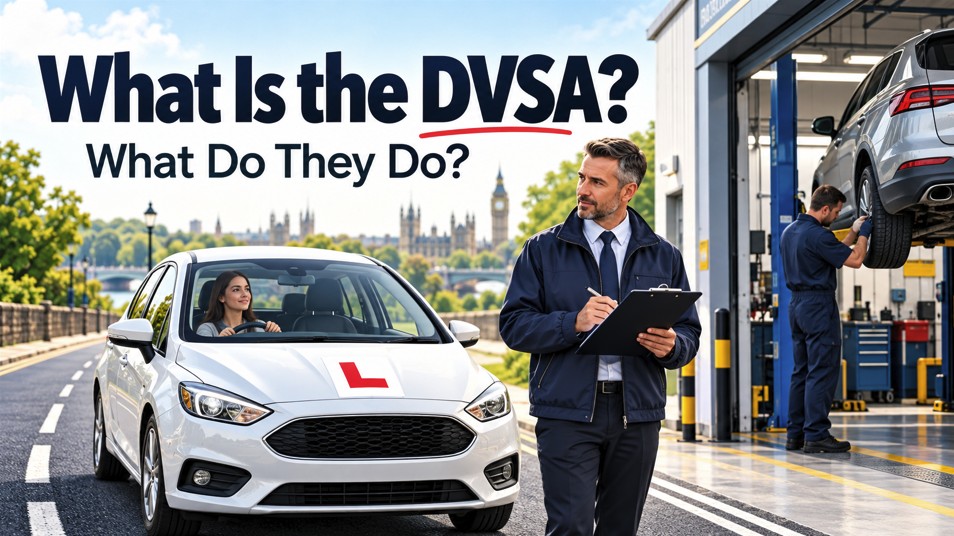
The DVSA’s work falls into six main areas.
1. Setting and running driving tests
The DVSA writes the theory test, trains and employs the examiners who conduct practical tests, and decides the standard you need to reach to pass. This applies to cars, motorcycles, lorries and buses.
Every examiner in Great Britain marks against the same national standard, so your test at Morden is judged in exactly the same way as a test in Manchester or Glasgow. When you sit your test at Morden, Tolworth or any other centre, your examiner works for the DVSA.
The agency is also working to increase test capacity. As of April 2026 it employed 1,604 full-time equivalent examiners, its highest number since 2018, and it has doubled its training capacity for new examiners.
2. Updating the driving test
The DVSA revises the test as roads and cars change. In December 2017, for example, it:
- extended independent driving to around 20 minutes, with most candidates following a sat nav
- moved one “show me” question to while you’re driving
- introduced new reversing manoeuvres, such as pulling up on the right and reversing two car lengths
Recent theory test updates reflect modern driving too, including questions on electric vehicles, eco-driving and emergency first aid.
3. Approving and monitoring driving instructors
Anyone who charges for driving lessons must be a DVSA Approved Driving Instructor (ADI) or a trainee holding a DVSA licence. To qualify, instructors must pass three demanding tests covering theory, their own driving ability and their teaching ability.
Once qualified, ADIs appear on the official register and are regularly assessed through the DVSA’s Standards Check to make sure their teaching stays at the required level.
Tip: Qualified instructors display a green ADI certificate in the windscreen, and trainee instructors display a pink one. If you’re unsure, ask to see it before your first lesson.
4. Publishing official learning materials
The DVSA produces the official resources used to prepare for the theory test, including revision questions, hazard perception practice clips and guidance on the driving syllabus. Anything branded “official DVSA” is the source the test is built from.
5. Overseeing MOTs and vehicle safety
The DVSA sets the standards for the annual MOT, approves the garages and testers who carry it out, and can withdraw that approval if standards slip. It also monitors vehicle safety recalls, so when a manufacturer finds a dangerous defect, owners are told and the fault is fixed.
6. Roadside enforcement
DVSA enforcement officers check lorries, buses and coaches at the roadside and at operators’ depots, looking at roadworthiness, drivers’ hours and load safety. Unsafe vehicles can be taken off the road. The DVSA also oversees the Driver Certificate of Professional Competence (CPC), the extra qualification that professional lorry, bus and coach drivers must hold and keep up to date.
DVSA vs DVLA: what’s the difference?
The two agencies are often confused, but they do very different jobs.
| DVSA | DVLA | |
|---|---|---|
| Full name | Driver and Vehicle Standards Agency | Driver and Vehicle Licensing Agency |
| Main role | Sets and enforces driving and vehicle standards | Keeps licence and vehicle records |
| For learners | Runs your theory and practical tests | Issues your provisional and full licence |
| Instructors | Approves and checks ADIs | No role |
| Vehicles | Oversees MOTs and safety recalls | Handles registration and vehicle tax |
A simple way to remember it: the DVLA gives you the licence; the DVSA decides whether you’ve earned it.
As a learner, you deal with both. You apply to the DVLA for your provisional licence, then book your theory and practical tests with the DVSA. When you pass, your examiner can send your details straight to the DVLA so your full licence is issued.
How much are DVSA test fees in 2026?
| Test | Fee |
|---|---|
| Car theory test | £23 |
| Car practical test (weekday) | £62 |
| Car practical test (evening, weekend, bank holiday) | £75 |
These fees are set by the DVSA, so no driving school or instructor can discount them. The theory test fee has stayed the same since 2010.
Theory test pass marks: you need at least 43 out of 50 on the multiple-choice section and 44 out of 75 on hazard perception, both in the same sitting. Your pass certificate lasts two years, and you must pass your practical test within that time or sit the theory again.
The new DVSA booking rules for 2026
This year the DVSA introduced the biggest changes to test booking in years, aimed at stopping bots and resellers from grabbing test slots and selling them on at inflated prices.
- Two-change limit (since 31 March 2026): you can make only two changes to a booking. Changing the date, time or test centre, or swapping with another learner, each count as one change. Cancelling and rebooking resets the limit.
- Learner-only booking (since 12 May 2026): only the learner can book, change or cancel their own car test. Instructors, parents, unofficial booking sites and cancellation-finder apps can no longer do it for you.
- Nearby test centres only (since 9 June 2026): if you change your test centre, you can only move to your original centre or one of the three closest alternatives.
Your instructor can’t book for you any more, but their advice matters more than ever. With only two changes allowed, booking at the right moment, when you’re genuinely ready, saves you money and stress. We explain the process step by step in our guide to booking your practical driving test under the new DVSA rules.
Always book through GOV.UK. Unofficial sites often book the same test on the same DVSA system and charge you extra for it.
Why the DVSA matters to you as a learner
Every stage of learning to drive, from your theory test to your instructor’s qualifications to the standard you’re marked against on test day, traces back to the DVSA. Understanding how it works helps you:
- choose a properly qualified instructor
- avoid paying third-party booking fees
- plan your test date around the two-change limit
- know exactly what standard you’re working towards
Learning to the DVSA standard with Glow Driving School
Every Glow instructor is DVSA-approved, and our lessons are built around the same standard your examiner uses on test day. We track your progress against 47 core DVSA competencies and give you written feedback after every session, so you always know which areas are test-ready and which need more work.
We’ve been teaching in South West London since 2018, so we know how DVSA examiners use local roads, from the dual carriageways and roundabouts around Morden Test Centre to the busy multi-lane junctions near Tolworth. That means you practise the situations you’ll actually meet on test day.
Ready to learn with an instructor who teaches to the DVSA standard? Book your first lesson or message us on WhatsApp.
FAQs
1. What does DVSA stand for?
DVSA stands for the Driver and Vehicle Standards Agency, an executive agency of the Department for Transport responsible for driving tests, instructor approval and vehicle safety standards in Great Britain.
2. What is the difference between the DVSA and the DVLA?
The DVLA issues driving licences and keeps vehicle records. The DVSA runs driving tests, approves driving instructors and oversees MOTs and vehicle safety.
3. Is the DVSA the same as the DSA?
Yes, in effect. The Driving Standards Agency merged with the Vehicle and Operator Services Agency in 2014 to form the DVSA.
4. Does the DVSA cover Northern Ireland?
No. The DVSA covers England, Scotland and Wales. Driving tests in Northern Ireland are run by the Driver & Vehicle Agency (DVA).
5. How much does a DVSA driving test cost in 2026?
The car theory test costs £23. The car practical test costs £62 on weekdays and £75 for evenings, weekends and bank holidays.
6. Can my driving instructor book my test for me?
No. Since 12 May 2026, only the learner can book and manage their own car driving test. Your instructor can still advise you on when you’re ready and manage their own availability.
7. How many times can I change my driving test?
You can make two changes to a booking, including changing the date, time or test centre. After that you must cancel and rebook, which resets the limit.
8. How do I check if my driving instructor is DVSA-approved?
Qualified instructors display a green ADI certificate in the car windscreen, and trainees display a pink one. You can also ask your instructor for their ADI number.
9. How can I contact the DVSA?
The DVSA’s contact details and official booking services are on GOV.UK. Always use the official site rather than third-party services, which may charge extra fees.