Booking a DVSA theory test takes about ten minutes and costs £23 on GOV.UK. The parts that catch people out are the rule changes that landed in 2026, and the fact that your nearest theory test centre almost certainly isn’t the same place as your practical test centre.
If you’re learning to drive in Wimbledon, Morden, Mitcham or anywhere else across South West London, the theory test is the gate between your provisional licence and a practical test date. You can’t book the practical until you’ve passed it.
The booking itself is simple. What follows covers what you need to hand, where to book, which theory centres actually serve this part of London, what changed in 2026, and what the test contains, so you’re not learning any of it on the day.
The short version
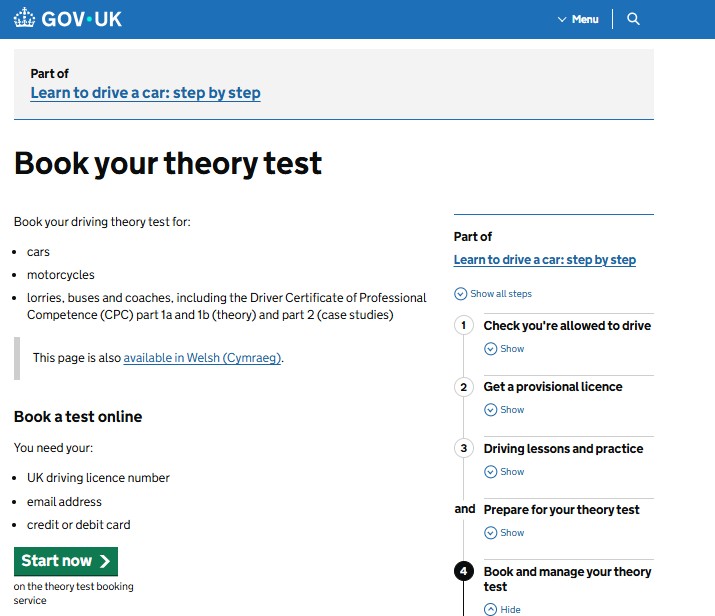
Book at gov.uk/book-theory-test. You’ll need your provisional driving licence number, an email address and a debit or credit card. The fee is £23 for a car or motorcycle test, and you must pass both sections in the same sitting.
- Test fee
- £23
- Multiple choice
- 43/50
- Hazard perception
- 44/75
- Pass valid for
- 2 years
What changed in 2026
You now have to book the test yourself
From spring 2026, learner drivers must book their own theory and practical tests directly on GOV.UK. Instructors can no longer book on a pupil’s behalf. If you were expecting your instructor to sort it out for you, that’s the change to know about the account, the licence details and the payment all have to come from you.
Two other updates are worth building into your revision:
- First aid questions. The multiple-choice bank now includes questions on CPR and using a defibrillator, added under the incidents and emergencies topic in partnership with Resuscitation Council UK. You won’t be asked to demonstrate anything physically, it’s knowledge, tested on screen.
- More difficult hazard perception footage. The clip library has been widened with material filmed at night and in rain and fog. If you’ve only ever practised on bright, dry daytime clips, practise on the harder conditions too.
The fee, the format and the pass marks are unchanged.
Where to book and what to avoid
Search “book theory test” and you’ll get the official service alongside a row of commercial booking sites. They all book the same test, at the same centres, on the same DVSA system. The difference is what you pay: third-party sites typically add £10–£40 on top of the £23 as a service fee.
Some of those companies bundle in revision material or booking assistance, which is a legitimate product if that’s what you want. But none of them can get you a slot the official service can’t, and none of them make the test easier. If you just want the standard DVSA appointment at the standard price, go to GOV.UK directly rather than clicking the first sponsored result.
Northern Ireland runs a separate service through the DVA. The fee is the same £23, but the booking route is different.
What you need before you start
- Your UK provisional driving licence, and the licence number from it
- An email address you check regularly
- A debit or credit card
- To meet the residency requirement on the day of the test
If you don’t have a provisional licence yet, that comes first. A first application in Great Britain costs £34 online through DVLA. You can’t book a theory test without the licence number.
The 185-day residency rule
To sit a theory or practical test you normally need to have lived in England, Wales or Scotland for at least 185 days in the 12 months before the date you take it.
Note that it hangs on the test date, not the booking date. This matters most for learners who’ve recently moved to the UK, we teach a lot of them across Wimbledon and Tooting, and it’s a common source of confusion. Holding a provisional licence doesn’t automatically mean the residency condition is met. If your situation is at all unusual, check the current GOV.UK eligibility guidance before you pay.
How to book, step by step
-
Open the official service
Start at gov.uk/book-theory-test rather than a search advert. Check the address bar shows gov.uk before entering anything.
-
Declare any support needs
You’ll be asked whether you have a reading difficulty, disability or health condition. Answer honestly. Extra time and other arrangements have to be requested at this stage, turning up on the day expecting adjustments that were never requested doesn’t work.
-
Enter your licence and contact details
Your licence number identifies your driving record, so copy it exactly as printed. A typo here causes more problems than anything else in the process.
-
Choose the test category
Most learners want the car theory test. Motorcycle, lorry and bus categories sit alongside it, don’t click through without checking which one is selected.
-
Pick a test centre
Search by postcode and look at how you’d actually travel there on the morning. A centre on a direct train line often beats one that’s closer on a map but awkward to reach.
-
Choose a date and time
If your preferred date isn’t showing, check the days either side and a second centre before assuming nothing’s available. Pick a time of day you think clearly at, with enough margin to arrive unhurried.
-
Check everything, then pay
Review your name, licence number, category, centre, date, time and support arrangements before paying the £23. Let the payment finish processing without refreshing or clicking again.
-
Save the confirmation
Put the appointment in your phone calendar with a reminder, and keep the confirmation email. That date is now your revision deadline.
Theory test centres near South West London
This trips people up constantly
Morden and Mitcham are practical test centres. Neither runs theory tests. Our learners regularly assume they’ll sit the theory at Morden because that’s where they’ll take their practical — it doesn’t work that way.
Theory tests are delivered at a separate network of Pearson VUE centres. The ones that usually come up for learners across Merton, Wandsworth and Lambeth are:
- Croydon CR0 — best from Mitcham & Norbury
- Kingston upon Thames KT1 — best from Wimbledon & Putney
- Southwark SE1 — best from Clapham & Battersea
Addresses occasionally move, so confirm the current one on the booking service when you choose your slot. Once you’ve passed, your practical will most likely be at Morden or Tolworth, and those are the routes we teach.
What’s actually in the test
It’s one appointment of roughly 90 minutes, in two parts, with a short optional break between them. You have to pass both in the same sitting — there’s no carrying one half forward.
Multiple choice
Fifty questions in 57 minutes, drawn at random from a bank of more than 700. You need 43 correct, which allows exactly seven wrong answers. You can flag questions and come back to them before the section ends.
One of those 50 arrives as a short silent video clip of a real driving situation, with three questions attached to it. You can replay the clip as often as you like within the section time. It’s there to test judgement rather than recall, which is why memorising answers without understanding the rule behind them tends to fall apart.
Hazard perception
Fourteen video clips, 75 points available, 44 needed to pass. You click when you spot a hazard developing into something that would make a driver slow down, change direction or otherwise act.
Clicking constantly doesn’t work — the scoring system detects it and can void a clip. The skill is recognising the moment a situation turns from background activity into a genuine developing hazard, and that’s a different skill from answering questions. Practise it separately, and practise on a mouse rather than a phone screen, because that’s what you’ll use on the day.
Fewer than half of candidates pass first time nationally. Nearly all of the ones who fail were underprepared rather than unlucky.
Can you take the theory test in another language?
No. The UK theory test is available in English and Welsh only.
Foreign-language voiceovers and interpreters were withdrawn in April 2014 and haven’t returned. There’s no French, Polish, Urdu, Romanian or any other language option, and no arrangement for bringing a translator.
What does exist is support for a reading difficulty, disability or health condition — including an English-language voiceover through headphones and, in some circumstances, extra time. Request it during booking. If English isn’t your first language, build revision time around reading the Highway Code in English rather than hoping for a translated test.
What to take on the day
Your UK photocard driving licence. That’s the item to put at the top of the list — arrive without it and you can be refused the test and lose the fee. Check the current GOV.UK “what to take” guidance a few days beforehand in case anything’s changed.
Aim to arrive around 15 minutes early. You’ll get a short practice session on the touchscreen before the real questions start.
If you fail
You’ll get a breakdown showing which section let you down. Use it rather than just rebooking on reflex.
If it was multiple choice, identify the topics where your knowledge is thinnest and revise those specifically. If it was hazard perception, spend your time understanding how hazards develop rather than trying to click faster.
You have to wait at least three working days before retaking, and you retake the whole test — both sections, full £23 — even if you passed one of them.
Changing or cancelling your booking
You can move or cancel through the same GOV.UK service. Give at least three full working days’ notice for a theory test or you lose the fee. Check the current rules before making a late change, because the notice periods for theory and practical tests are different.
Your pass lasts two years — plan around that
The theory pass certificate is valid for two years from the date you sit it, not from when you booked. Pass your practical inside that window or you’ll be taking the theory again.
Two years sounds generous until you factor in practical test waiting times, which have been long across South West London. The sensible pattern is to pass theory once you’re genuinely progressing in lessons, then book the practical quickly so you’re holding a date rather than burning months of your window.
There’s no need to pause lessons while you revise. The two reinforce each other — road positioning, observation and anticipation all make more sense once you’ve felt them from the driver’s seat, which is why we usually suggest booking theory a few weeks into regular lessons rather than before you’ve started.
DVSA or DVLA?
Two agencies, regularly confused. The DVLA handles driving licences and vehicle records — that’s who issues your provisional. The DVSA runs driving tests and sets driving standards — that’s who your theory test belongs to, delivered through GOV.UK.
How to prepare properly
Treat the appointment as a deadline, not a finish line. Three areas need covering: the Highway Code and the rules behind it, answering questions accurately under time pressure, and hazard perception as its own skill.
Use the official DVSA revision material and app, then move to full-length mock tests under realistic conditions — timed, no interruptions, no looking things up.
Don’t aim for 43 and 44. Aim to sit comfortably above both marks in practice, so nerves and a couple of unfamiliar questions on the day don’t cost you the pass.
Common questions
How much does a theory test cost in 2026?
£23 for a car or motorcycle theory test booked on GOV.UK, covering both sections in one appointment. Lorry and bus theory tests cost £26. The car fee has been £23 since 2010.
Do I need a provisional licence to book?
Yes. The booking service needs your provisional driving licence number, so apply for the licence first. A first GB application costs £34 online.
Can my instructor book the test for me?
No. From spring 2026, learners must book their own theory and practical tests directly on GOV.UK. Instructors can no longer book on a pupil’s behalf.
Where’s my nearest theory test centre in South West London?
Usually Croydon, Kingston upon Thames or Southwark. Morden and Mitcham are practical test centres and don’t run theory tests. Confirm the current address through the booking service.
What score do I need to pass?
43 out of 50 on multiple choice and 44 out of 75 on hazard perception, both in the same sitting.
What if I pass one part and fail the other?
You’ve failed the test overall and have to retake both sections. There’s no partial pass to carry forward.
How soon can I retake it?
At least three working days after the failed attempt, and you pay the full £23 again.
How long does a theory pass last?
Two years from the date you pass. If you haven’t passed your practical test by then, you take the theory again.
Can I book my practical test before passing theory?
No. Standard learner car drivers must pass the theory test before the practical can be booked.
Can I take the theory test in a language other than English?
No. It’s available in English and Welsh only. Foreign-language voiceovers and interpreters were removed in April 2014.
Is GOV.UK the official booking site?
Yes, for England, Scotland and Wales. Northern Ireland uses a separate DVA service. Everything else is a third-party reseller adding a fee on top of the £23.
How long is the whole appointment?
Around 90 minutes: up to 57 minutes for the multiple-choice section, a short optional break, then roughly 20 minutes of hazard perception clips.
Passed your theory? Let’s get you test-ready
We teach the Morden and Tolworth test routes week in, week out — the roundabouts, the dual carriageways and the residential zones examiners actually use. Manual and automatic, beginners and nervous drivers, with door-to-door pickup across Wimbledon, Mitcham, Morden, Tooting, Balham and Putney.
Fees, pass marks and rules in this guide are taken from official DVSA and DVLA guidance on GOV.UK and were checked in September 2026. Requirements can change, so confirm current details on GOV.UK before you pay.