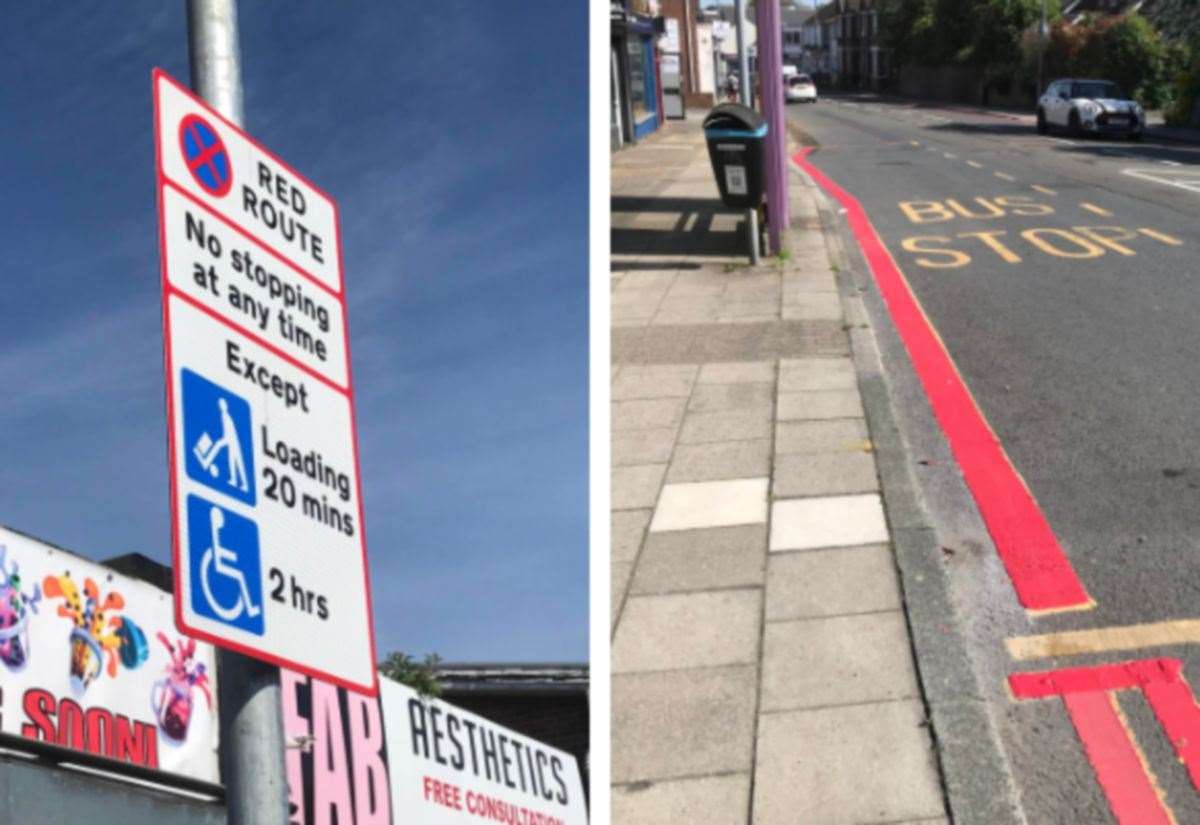
A red line appears along the road edge. No clear sign is visible nearby. Most new drivers pause at this moment unsure whether stopping is permitted, restricted, or entirely prohibited.
Red routes are designated high-priority roads where stopping and parking restrictions apply at all times or during specified hours to maintain consistent traffic flow. Transport for London manages 580 kilometres of red routes across Greater London, covering 5% of the road network yet carrying 30% of the city’s traffic. Red routes also operate in major UK cities, including Birmingham, Manchester, and Leeds.
This guide covers red route markings, single and double red line rules, parking bay permissions, sign variations, and Penalty Charge Notices giving every driver a complete, factual understanding of red routes before encountering them on the road.
At Glow Driving School in Wimbledon, we prepare our students for real road scenarios including navigating red routes with confidence.
What Is a Red Route?
A red route is a priority traffic corridor marked by single or double red lines along the kerb, where stopping and parking restrictions apply at all times or during signed hours.
Transport for London introduced red routes in 1991, starting with a pilot on the A316 in southwest London. The scheme addressed one specific problem: illegal parking on key roads was slowing traffic across the entire city. The Department for Transport later formalised red route powers under the Traffic Management Act 2004.
These restrictions apply across the Transport for London Road Network, known as the TLRN 580 kilometres of road spanning Greater London. That 580 kilometres represents just 5% of London’s total road length, yet the TLRN carries 30% of all London traffic every day.
Red routes differ from yellow lines in three measurable ways. Red lines fall under TfL jurisdiction, not local borough councils. TfL Civil Enforcement Officers issue penalties on red routes, separate from standard parking wardens. Double red lines prohibit stopping at all times, whereas double yellow lines permit brief stops in several circumstances.
Outside London, red route-style corridors operate on major roads in Birmingham, Leeds, and Manchester, enforced by local highway authorities under the same Traffic Management Act 2004 framework.
Red Route Road Markings and Signs Explained
Red route road markings appear in 5 distinct forms across the UK road network, each communicating a specific restriction level, time condition, or permitted use. Understanding each marking type removes uncertainty before a driver reaches the road.
Double Red Lines
Double red lines are a total stopping prohibition, painted continuously along the kerb edge on both sides of the carriageway. Transport for London enforces this restriction 24 hours a day, 7 days a week, with no time-based exemptions for standard vehicles. No stopping, parking, loading, or passenger drop-off is permitted on double red lines at any time.
Single Red Lines
Single red lines are a time-restricted stopping prohibition, active only during the hours displayed on the accompanying kerb-side sign. Restriction hours vary by road, commonly covering 7am to 7pm on weekdays. Outside these hours, brief stopping is permitted, but the kerb-side sign remains the definitive authority on permitted times.
Red Route Sign Variations
Red route signs UK display 3 core formats: a white rectangular plate with red border indicating no stopping during stated hours, a plate with loading bay permissions, and a red route controlled zone entry sign marking the start of a restricted corridor. Each sign carries the exact restriction hours, permitted vehicle categories, and maximum waiting durations.
Kerb Markings
Kerb markings meaning varies across 2 primary types on red routes. Yellow kerb marks indicate loading restrictions, while the absence of kerb marks within a designated bay signals permitted loading activity during bay operational hours.
Red Route Parking Bays
Red route parking bays are marked rectangular zones painted within the red route corridor, permitting specific vehicle categories to stop during displayed hours. Each bay sign carries 3 data points: permitted vehicle type, operational hours, and maximum stay duration. Bays reserved for loading display “Loading Only” with a time plate, while shared-use bays display both parking and loading permissions with separate time conditions.
Rules of Red Routes — What You Can and Cannot Do
Red routes carry 4 categories of permitted activity and 3 categories of prohibited activity, each defined by road marking type, signed permissions, and vehicle classification. Knowing which category applies at a given point on the road determines every legal stopping decision.
What You Can Do on a Red Route
Drivers hold 4 permitted actions on a red route, each conditional on marking type or signed bay presence.
- Drive through the red route corridor without restriction at any time.
- Use a designated parking bay where a bay sign displays the permitted vehicle category, operational hours, and maximum stay duration.
- Load or unload within a marked loading bay during the hours stated on the bay’s time plate.
- Drop off or collect passengers at a point where no double red line is present and a signed bay or time-restricted single red line permits brief stopping.
What You Cannot Do on a Red Route
Drivers face 3 absolute restrictions on red routes, each enforced through Penalty Charge Notices issued by Transport for London or the relevant local authority.
- Stop on double red lines at any time, for any duration, regardless of vehicle type.
- Park on single red lines during the restriction hours displayed on the kerb-side sign.
- Wait on a red route without a valid exemption, including stationary idling, passenger collection without signed permission, and commercial vehicle holding.
Exemptions and Special Cases
Three vehicle categories hold conditional red route exemptions under UK traffic regulation orders.
- Emergency vehicles — police, ambulance, and fire service vehicles stop on red routes during active operational duties without restriction.
- Blue Badge holders — disabled drivers receive modified permissions on red routes, with specific conditions covered in the parking section of this guide.
- Licensed taxis and private hire vehicles black cabs and licensed PHVs hold limited set-down permissions on red routes where local traffic orders permit, covering designated points only and not open-road stopping.
Parking on Red Routes
Parking on a red route follows four distinct rules each determined by line type, sign instructions, badge status, and bay markings. Understanding each rule prevents a Penalty Charge Notice (PCN) of up to £160 in Greater London.
Parking on Double Red Lines
Parking on double red lines is prohibited at all times, covering every day of the week including bank holidays, with no time-based exceptions for standard vehicles.
Double red lines are stricter than double yellow lines in one direct way. Double yellow lines permit loading and unloading in most cases unless kerb marks indicate otherwise. Double red lines remove that permission entirely no stopping, no loading, no waiting, at any hour.
TfL Civil Enforcement Officers patrol double red line corridors continuously, and cameras mounted on enforcement vehicles capture violations within seconds of stopping.
Parking on Single Red Lines
Parking on single red lines is time-restricted, with permitted hours displayed on an accompanying rectangular sign mounted on a nearby post.
Each sign states three pieces of information: the restricted days, the restricted hours, and the road name or zone reference. For example, a sign reading “No stopping Mon–Sat 7am–7pm” means parking outside those hours is permitted on that specific kerb stretch. The sign background is white with red text, matching the kerb line colour for immediate visual connection.
Outside the signed hours, single red line parking follows the same rules as an unrestricted road a driver parks, stops, and waits without penalty.
Disabled Parking on Red Routes
Blue Badge holders park on single red lines outside restricted hours, identical to standard drivers. On double red lines, Blue Badge rules differ from all other road types — badges do not automatically permit stopping or parking on double red lines within the TLRN.
TfL designates specific red route locations where Blue Badge holders park for up to 3 hours, identified by a “disabled” bay sign or a supplementary plate attached below the main red route sign. Without that specific designation, a Blue Badge carries no exemption on a double red line.
This differs from non-TLRN roads across the UK, where Blue Badge holders park on double yellow lines for up to 3 hours in most circumstances.
Red Route Parking Bays
Red route parking bays are marked kerb sections within a red route corridor where stopping and parking are permitted under specific conditions signed above or beside the bay.
Identify a red route bay by three visual markers: a white painted box on the road surface, a blue or white sign on a post at the bay entrance, and a supplementary plate below the sign stating permitted users. Those users include pay-and-display drivers, permit holders, loading vehicles, or a combination of all three.
Read a bay sign in this order: permitted user type at the top, permitted days and hours in the middle, and maximum stay duration at the bottom. A bay sign reading “Parking — Mon–Fri 8am–6:30pm — 1 hour maximum return prohibited within 1 hour” means a driver parks for up to 60 minutes on weekdays within those hours, then vacates and stays away for a minimum of 60 minutes before returning.
Red Route Fines and Penalty Charge Notices (PCN)
A red route PCN is a Penalty Charge Notice — a civil financial penalty issued to any vehicle that stops, parks, or waits in violation of red route restrictions. Transport for London issues PCNs on the TLRN network, while local authorities issue PCNs on red routes outside Greater London.
In 2025, TfL issues red route parking fines at 2 charge levels. A higher-level contravention carries a £130 fine, reduced to £65 if paid within 14 days. A lower-level contravention carries a £80 fine, reduced to £40 if paid within 14 days. Stopping on double red lines attracts the higher-level charge in most enforcement cases.
An ignored PCN escalates through 4 stages: the original PCN, a Notice to Owner sent to the registered keeper, a charge certificate increasing the penalty by 50%, and a court order authorising debt recovery. At the court order stage, the total charge reaches £195 for a higher-level contravention.
To appeal a red route PCN, drivers follow 3 sequential steps:
- Submit an informal challenge to TfL within 14 days of the PCN issue date, citing the specific grounds for dispute
- Submit a formal representation if the informal challenge is rejected, addressed to TfL’s Penalty Processing team
- Appeal to the independent Traffic Penalty Tribunal if the formal representation is also rejected, at no cost to the driver
Three consistent practices reduce red route parking fine exposure:
- Check kerb-side signs before stopping on any road with red line markings
- Identify bay operational hours using the time plate displayed above each bay
- Confirm Blue Badge exemption conditions on each individual red route before stopping
How to Drive on Red Routes Confidently
To drive on red routes confidently, learner drivers identify red line markings, understand signed restrictions, and plan each journey before entering the TLRN.
Google Maps and Waze both display red route roads across Greater London. Searching the destination before driving reveals which sections of the A3, A4, A316, or A13 fall under TLRN red route restrictions. Identifying these roads in advance removes uncertainty at the wheel.
Four mistakes learner drivers make on red routes include stopping to check directions, pulling over to answer a phone, waiting for a passenger beyond a signed bay, and confusing single red line hours with double red line rules. Each of these produces a Penalty Charge Notice of up to £160 in Greater London.
Urgent stops on a red route follow one accepted procedure. Pull into the nearest marked bay, a side street, or a legal layby. Stopping on the red line itself even for 30 seconds carries the same PCN risk as a prolonged stop.
Learner drivers who practise on TLRN roads before their test encounter red route signage, kerb markings, and bay restrictions in real traffic conditions. For learners in wimbledon, automatic driving lessons can provide practical experience of handling busy urban roads and navigating these restrictions confidently. At Glow Driving School, Wimbledon-based instructors build red route navigation into every London lesson, covering live road markings, signed bay rules, and correct stopping procedure across actual TLRN corridors.
Frequently Asked Questions
Can You Stop on a Red Route to Drop Someone Off?
Stopping to drop someone off on a red route is permitted only where a signed bay explicitly allows passenger boarding. On double red lines, stopping for any purpose is prohibited at all times. On single red lines, the kerb-side sign determines permitted hours.
Is a Red Route the Same as a Red Line?
A red route and a red line are two distinct designations. A red route is the classified road corridor managed by Transport for London. A red line is the physical road marking painted along the kerb edge within that corridor, indicating the specific restriction level.
What Is the Fine for Parking on a Red Route in London?
The Penalty Charge Notice for a red route violation in London is £160, issued by Transport for London. Payment within 14 days reduces the fine to £80. Non-payment within 28 days escalates the charge to £240.
Can Blue Badge Holders Park on Red Routes?
Blue Badge holders are not automatically exempt from red route restrictions. Parking on double red lines remains prohibited for badge holders. Stopping for up to 3 minutes for passenger boarding or alighting is permitted, and designated disabled bays within the red route corridor are accessible where signed.
Are Red Routes Only in London?
Red routes operate across multiple major UK cities, including Birmingham, Manchester, and Leeds, in addition to London’s 580-kilometre Transport for London Road Network. Each local authority designates and enforces red routes independently under the Road Traffic Regulation Act 1984.
What Is the Difference Between Red Routes and Yellow Lines?
Red routes and yellow lines differ across 3 key dimensions: enforcement authority, restriction severity, and geographic scope. Yellow lines are enforced by local councils, apply borough-wide, and permit time-restricted loading. Red routes are enforced by Transport for London on designated high-traffic corridors, with stricter 24-hour prohibitions on double red lines.
How Do I Know If a Road Is a Red Route?
A road is identifiable as a red route through 3 physical indicators: a red line painted along the kerb edge, a rectangular white sign with a red border displaying restriction hours, and a red route zone entry sign at the corridor boundary. Transport for London’s street map also identifies all 580 kilometres of designated red routes across Greater London.
Conclusion
Red routes cover 580 kilometres of Greater London’s road network, carrying 30% of the city’s traffic across 5% of its roads. Transport for London enforces 4 distinct restriction types on these corridors — double red lines, single red lines, controlled parking bays, and kerb-marked loading zones — each governed by specific time conditions and permitted vehicle categories. Penalty Charge Notices on red routes carry fines of up to £130 in Greater London, reduced to £65 on payment within 14 days. Knowing each marking, sign, and restriction type keeps every driver compliant, informed, and confident on London’s busiest roads.
Glow Driving School in Wimbledon delivers structured, road-accurate driving lessons across Greater London, covering real traffic scenarios including red route navigation, controlled zone awareness, and road marking interpretation.
Ready to drive London’s roads with confidence? Book your driving lesson with Glow Driving School in Wimbledon today and learn how to handle every road marking, sign, and rule including red routes.
Leave a Reply